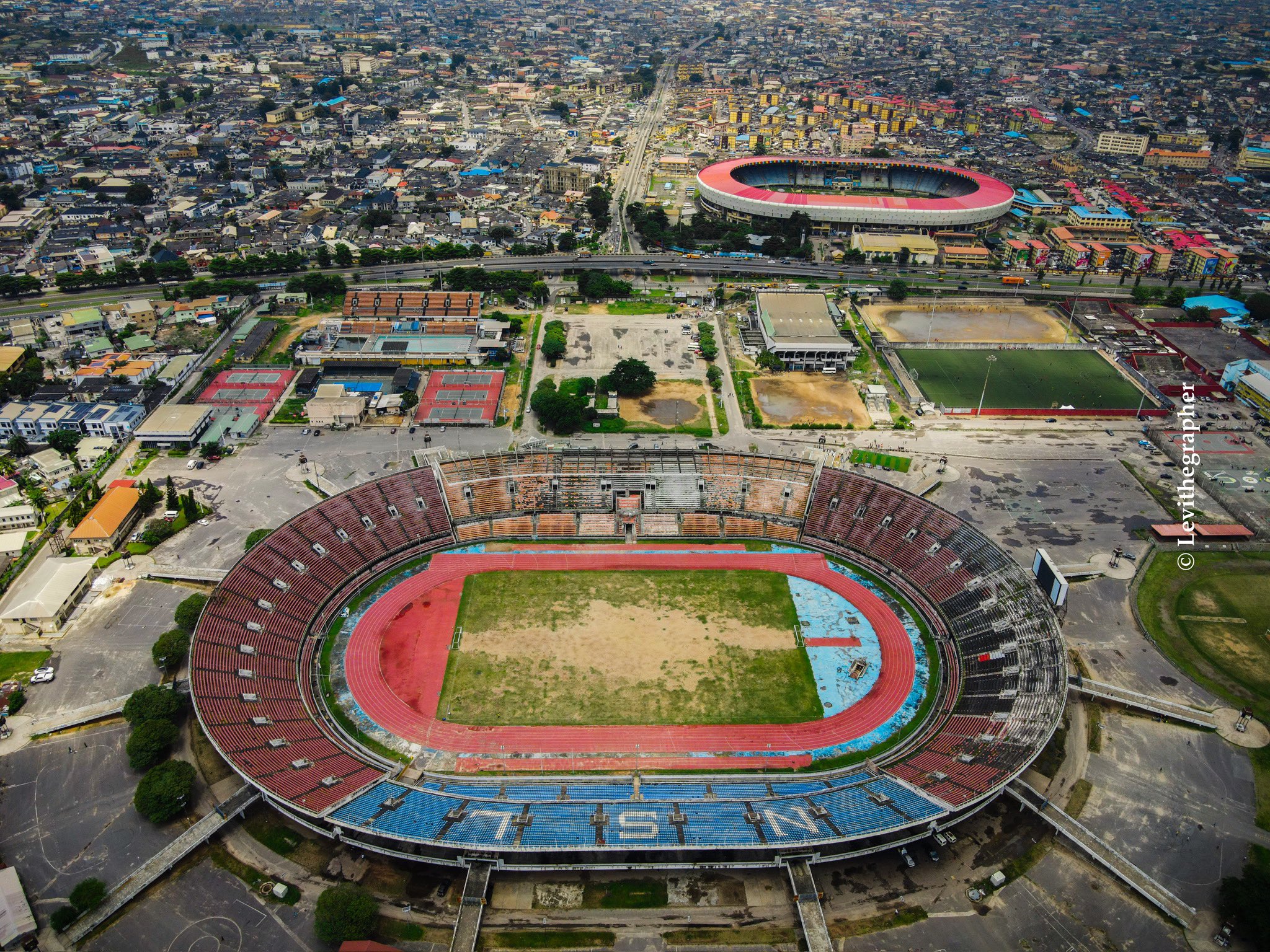
'''National Stadium Surulere''', officially the '''Lagos National Stadium''', is a multi-purpose sports arena located in Surulere, Lagos State, Nigeria. Constructed in 1972 under General Yakubu Gowon's administration to host the 1973 All-Africa Games, it once symbolized Nigeria's sporting ambition with a capacity of 55,000 spectators. Renovated in 1999 to meet FIFA standards, reducing capacity to 45,000, the facility includes an Olympic-size swimming pool and arenas for athletics, basketball, and more. However, neglect since the early 2000s led to its dilapidation, with operations shifting to the adjacent Teslim Balogun Stadium. Partial renovations began in 2022 under the "Adopt-a-Pitch" initiative, focusing on the pitch and basic infrastructure, but as of October 2025, full restoration remains incomplete amid ongoing decay and calls for urgent intervention.
| Coordinates | coord | 6 | 29 | 49 | N | 3 | 21 | 53 | E | display=inline,title |
|---|---|---|---|---|---|---|---|---|---|---|
| Location | Surulere, Lagos State, Nigeria | |||||||||
| Construction Started | 1972 | |||||||||
| Opened | 1973 | |||||||||
| Renovated | 1999; partial 2022-ongoing | |||||||||
| Architect | Not specified (Bulgarian influence speculated) | |||||||||
| Owner | Federal Government of Nigeria | |||||||||
| Capacity | 45,000 | |||||||||
| Surface | Grass (re-grassed 2022) |
Geography and Location
The stadium occupies a 15-hectare site in Surulere, a densely populated suburb of Lagos, adjacent to the Teslim Balogun Stadium and near landmarks like the Wole Soyinka Centre for Culture and the Creative Arts. Elevated slightly above sea level, it sits amid urban sprawl, with access via the Lagos-Badagry Expressway and local roads like Alhaji Masha Road. The surrounding area features mixed-use developments, but encroachment by traders and mechanics has reduced open spaces. Its coastal proximity exposes it to high humidity and flooding risks, exacerbating maintenance challenges in Lagos's tropical environment.
Architecture
Designed in a functionalist style with brutalist elements, the stadium features a large oval bowl with tiered concrete stands under a partial cantilevered roof for shade. The main arena includes a central grass pitch (105m x 68m) surrounded by a 400m tartan track, flanked by indoor halls for aquatics and multi-sports. The Olympic-size swimming pool (50m) and diving facilities adjoin the east side, while spectator areas boast basic seating without modern amenities like covered enclosures. Renovations in 1999 added floodlights and scoreboards for international compliance, but current decay includes crumbling facades and rusted structures. Proposed upgrades envision sustainable features like solar panels, though unimplemented.
History
Initiated in 1972 as part of preparations for the 2nd All-Africa Games, the stadium cost approximately ₦600 million (equivalent to billions today) and opened triumphantly in 1973, where Nigeria topped the medal table. It hosted AFCON finals in 1980 and 2000, the 2003 FIFA U-20 World Cup, and national events until 2004. Post-2000s neglect stemmed from funding shortfalls and the Ministry of Sports' relocation to Abuja, leading to vandalism and informal occupation. In 2019, revival plans were announced, with 2022 marking the first major work under Minister Sunday Dare's initiative, including pitch re-grassing and cable repairs. By 2025, progress stalls due to bureaucratic delays, with experts warning of structural collapse risks.
Facilities
The complex spans multiple venues: - Main Bowl: 45,000 seats for football and athletics; includes scoreboard and changing rooms. - Swimming Arena: Olympic-standard pool for competitions and training. - Indoor Halls: For basketball, volleyball, wrestling, and table tennis; capacity ~5,000 each. - Ancillary: Press boxes, medical center, and parking for 2,000 vehicles. - Post-2022 Updates: Restored tartan track sections and basic lighting, but no full electrification.
Facilities remain underutilized, with the site partly serving as a marketplace.
Events and Performances
Historically vibrant, the stadium hosted: - 1973 All-Africa Games: Nigeria's 24-gold haul. - AFCON 1980/2000: Finals with 80,000+ crowds. - 2003 FIFA U-20 World Cup: Group stages and knockouts. Recent events are sparse; the last major in 2004 was a Four-Nation LG Cup. In 2025, it hosted minor local athletics meets amid renovations, with potential for youth festivals if completed.
Renovation and Current Status
The 2022 "Adopt-a-Pitch" program, backed by philanthropists like Aliko Dangote, addressed the pitch, scoreboard, and vandalized areas at ₦2-3 billion. However, March 2025 reports highlight persistent issues: overgrown weeds, broken AC units, and safety hazards, prompting public outcry and Building Collapse Prevention Guild alerts. Federal officials promise completion by year-end, aligning with national sports infrastructure revamps like MKO Abiola Stadium. As of October 2025, it's partially operational for training but unsuitable for internationals, serving as a cautionary tale of maintenance lapses.
Cultural Significance
The stadium embodies Nigeria's post-independence sporting zeal, fostering unity through events that drew diverse crowds. It launched careers of legends like Jay-Jay Okocha and inspired youth programs, contributing to the creative economy via broadcasts. Neglect symbolizes broader infrastructure woes, yet revival campaigns rally national pride, with artists and athletes advocating restoration.
Controversies
Privatization rumors in the 2010s sparked fears of commercialization, while 2025 viral videos of decay fueled criticism of government inaction. Encroachment by informal traders raises eviction concerns, and safety warnings underscore liability risks. Critics like former player Friday Ekpo decry delays, urging state-federal collaboration.
Economy and Tourism
Once generating millions in ticket sales and broadcasting rights, the stadium now yields minimal revenue, with Surulere's sports tourism shifting to nearby venues. Renovation could boost Lagos's GDP by hosting events, employing 500+, and attracting 100,000 visitors yearly. Adjacent markets sustain local trade, but full revival promises hospitality and merchandise growth.
See Also
- Teslim Balogun Stadium
- All-Africa Games
- Africa Cup of Nations
- Sports in Nigeria
References
Synthesized from sources as of October 2025