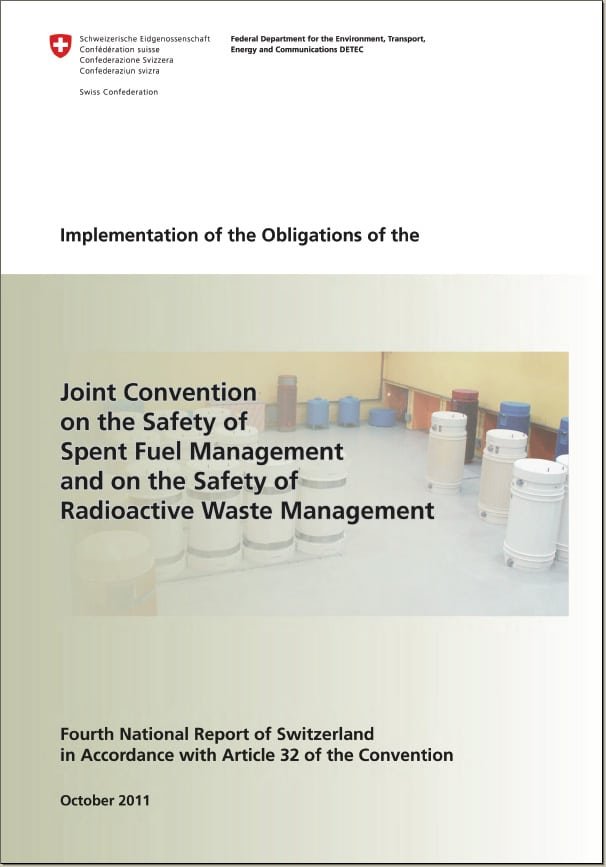
The Joint Convention on the Safety of Spent Fuel Management and on the Safety of Radioactive Waste Management is a 1997 treaty adopted under the auspices of the International Atomic Energy Agency (IAEA).
It is the first international treaty to address the management of radioactive waste on a global scale.
Content
- Parties to the convention commit to its provisions covering:
- Storage of nuclear waste.
- Transport of radioactive waste.
- Location, design, and operation of storage facilities.
- Requires periodic Review Meetings of contracting parties to assess national implementation.
- National reports are submitted and made available through the IAEA.
- Example: The Fourth Review Meeting was held in 2012, with a summary report and national reports published on the IAEA website.
Creation and Entry into Force
- Adopted: 29 September 1997, Vienna, Austria.
- Entered into force: 18 June 2001.
- Original signatories: 42 states.
Membership
- As of March 2025:
- 90 state parties + European Atomic Energy Community (EURATOM).
- Signatories not yet ratified: Lebanon, Philippines.
- States in bold have at least one operational nuclear power plant.
Purpose
- Strengthen nuclear safety and environmental protection worldwide.
- Foster international cooperation on radioactive waste management.
- Promote high safety standards and transparent reporting.
References
- International Atomic Energy Agency – Joint Convention(https://www.iaea.org/topics/joint-convention)
- IAEA, Summary Report of the Fourth Review Meeting, 2012.