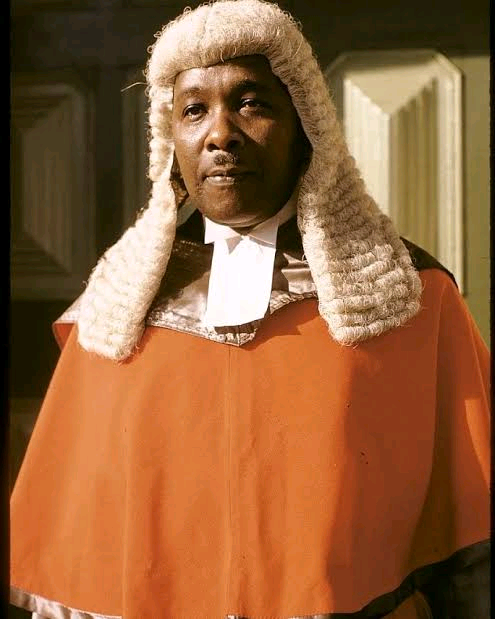
Omoba Sir Adetokunbo Adegboyega Ademola (1 February 1906 – 29 January 1993) was a distinguished Nigerian jurist, who served as Chief Justice of Nigeria from 1958 to 1972. A legal pioneer, he was the first Nigerian Chief Justice and played an instrumental role in the modernization of Nigeria’s legal system during both colonial and post-independence eras.
Early Life and Education
Born into Yoruba royalty in Abeokuta, Adetokunbo Ademola was the son of Oba Sir Ladapo Ademola II, the Alake of the Egba clan, and Princess Tejumade Ademola. His maternal uncle was Sir Adeyemo Alakija.
He began his early education at Roman Catholic School, Itesi and Holy Cross School, Lagos, before attending St. Gregory's Grammar School and King’s College Lagos.
After passing the Senior Clerical Examination in 1925, he joined the Colonial Civil Service as a clerk. From 1928 to 1931, he studied Law at Selwyn College, University of Cambridge, and was called to the Bar at Middle Temple, London in 1934.
Legal and Judicial Career
Upon his return to Nigeria in 1934, Ademola served as Crown Counsel, later working in Eastern Nigeria as Assistant Secretary. He entered private legal practice in 1936 and was appointed a Magistrate in 1939. His early postings included Warri, Lagos, and Opobo.
Notable milestones: - 1949: Appointed as a Puisne Judge, becoming the third Nigerian to hold the role. - 1955: Became Chief Justice of Western Nigeria — the first Nigerian to head a regional judiciary. - 1958: Appointed Chief Justice of the Federation, succeeding Sir Stafford Foster-Sutton.
Landmark Judgements & Role in National Affairs
As Chief Justice, Ademola was central to several landmark rulings: - Regina v. Ilorin Native Authority - Ayinke v. Ibidunni - Doherty v. Balewa - Aderemi v. Akintola - Olawoyin v. Commissioner of Police
He helped establish the Nigerian Law School (with Dr. Teslim Elias), ensuring legal training could occur domestically.
During political crises, he played a mediating role: - 1964: Helped break political deadlock after national elections. - 1966: Intervened during post-coup tensions to prevent northern secession.
Public Service and Later Life
Following retirement, Ademola chaired the Nigerian Census Board, overseeing the controversial 1973 national census. He also held various public service and international positions, including: - Member, UN International Public Service Advisory Board - Vice President, World Association of Jurists - President, Nigerian Red Cross - Member, International Olympic Committee - Olori-Oluwo (Grandmaster) of the Reformed Ogboni Fraternity
Honours and Titles
- Omoba (Yoruba prince)
- Knighted (KBE) by Queen Elizabeth II (1957)
- Member of the UK Privy Council (1963)
- Grand Commander of the Order of the Niger (GCON) – Nigeria’s second-highest national honour
Personal Life
He was married to Kofo Moore, a University of Oxford graduate and daughter of Eric Moore, a notable Nigerian diplomat. The couple had five children.
Legacy
Sir Adetokunbo Ademola is remembered as a trailblazer in Nigeria’s judicial system, who helped bridge colonial and independent eras. His legacy continues through legal institutions and reforms he championed, and he remains one of the most respected Chief Justices in Nigerian history.
```